| Welcome, Guest |
You have to register before you can post on our site.
|
| Online Users |
There are currently 6 online users.
» 0 Member(s) | 5 Guest(s)
Google
|
| Latest Threads |
Get a real government iss...
Forum: 2021
Last Post: jeannevol
Yesterday, 12:16 PM
» Replies: 0
» Views: 10
|
Get a real government iss...
Forum: 2022
Last Post: jeannevol
Yesterday, 12:15 PM
» Replies: 0
» Views: 13
|
Get a real government iss...
Forum: 2023
Last Post: jeannevol
Yesterday, 12:13 PM
» Replies: 0
» Views: 10
|
Get a real government iss...
Forum: 2025
Last Post: jeannevol
Yesterday, 12:08 PM
» Replies: 0
» Views: 11
|
Get a real government iss...
Forum: 2026
Last Post: jeannevol
Yesterday, 11:47 AM
» Replies: 0
» Views: 11
|
Get a real government iss...
Forum: 2020
Last Post: jeannevol
Yesterday, 11:43 AM
» Replies: 0
» Views: 9
|
Get a real government iss...
Forum: 2011
Last Post: jeannevol
Yesterday, 11:41 AM
» Replies: 0
» Views: 10
|
Get a real government iss...
Forum: 2012
Last Post: jeannevol
Yesterday, 11:40 AM
» Replies: 0
» Views: 11
|
Get a real government iss...
Forum: 2013
Last Post: jeannevol
Yesterday, 11:38 AM
» Replies: 0
» Views: 10
|
Get a real government iss...
Forum: 2014
Last Post: jeannevol
Yesterday, 11:37 AM
» Replies: 0
» Views: 9
|
|
|
| Record labels, Spotify sue pirate group Anna’s Archive over scraping and ‘brazen thef |
|
Posted by: MIPR - 01-24-2026, 11:26 PM - Forum: 2026
- No Replies
|
 |
Record labels, Spotify sue pirate group Anna’s Archive over scraping and ‘brazen theft’ of millions of tracks
January 21, 2026By Murray Stassen
Last month, a “decentralized group of online piracy websites” called Anna’s Archive revealed that it had scraped approximately 86 million music files from Spotify and planned to release them via BitTorrent.
Now, the three major music companies, Universal Music Group, Sony Music Entertainment, Warner Music Group, and music streaming giant Spotify have filed a lawsuit against the shadow library operation.
The complaint describes Anna’s Archive as formerly known as the “Pirate Library Mirror” and accuses it of “brazen theft of millions of files containing nearly all of the world’s commercial sound recordings.”
The lawsuit, which appears to have been filed under seal on December 26, 2025, was made publicly available on January 16, 2026 in the U.S. District Court for the Southern District of New York. You can read it in full here.
According to court documents, on January 2, the record labels obtained an emergency temporary restraining order, and on January 20, Judge Jed S. Rakoff issued a preliminary injunction after Anna’s Archive failed to appear at a hearing or file any response to the court.
The injunction, which you can read in full here, orders Anna’s Archive to cease all distribution of copyrighted works and prohibits them from hosting, linking to, or facilitating downloads of the scraped recordings.
The court also ordered domain registries, registrars, and hosting providers to disable access to Anna’s Archive domains including annas-archive.org, annas-archive.li, annas-archive.se, annas-archive.in, and annas-archive.pm.
The order specifically names Cloudflare, Public Interest Registry, and other service providers, requiring them to cease hosting services and preserve evidence that could identify those operating the sites.
The lawsuit notes that Anna’s Archive has illegally copied “metadata for about 256 million audio tracks (e.g., artist, album, and track name) and 86 million music files from Spotify, one of the world’s leading audio streaming services”.
The filing added: “Anna’s Archive has already released the metadata it unlawfully scraped, heralding it as, “the largest publicly available music metadata database.”
“Even more alarmingly,” it continued, “Anna’s Archive has threatened to imminently mass-release and freely distribute its pirated copies of the sound recording files to the public, without authorization from or compensation to the relevant rights holders”.
The complaint argues that “such widespread and illegal infringement would irreparably harm the music industry, including by materially interfering with the Record Company Plaintiffs’ right and ability to control their music catalog and to charge a fair market rate for their music, and by undermining the rights of the Record Company Plaintiffs’ licensees, like Spotify, to exploit their licenses and generate revenue from the Record Company Plaintiffs’ works.”
The labels and Spotify are bringing four causes of action: direct copyright infringement, breach of contract, violation of the Computer Fraud and Abuse Act, and violation of the Digital Millennium Copyright Act.
The record companies are seeking statutory damages of up to $150,000 per infringed work for copyright violations, or alternatively actual damages plus profits. All plaintiffs are also requesting $2,500 per act of technological circumvention under the DMCA, or actual damages in the alternative.
The complaint alleges that Anna’s Archive “circumvented Spotify technological measures by first surreptitiously accessing and downloading the music files at issue from Spotify using thousands of accounts, and then by circumventing the technological measures Spotify uses to protect audio files from unauthorized access.”
The operation allegedly employed automated scraping designed to mimic normal user behavior and avoid detection, violating Spotify’s Terms of Service in the process.
Anna’s Archive operates as an anonymous collective running shadow library websites at multiple domains. According to the filing, as “an organization dedicated to online piracy,” Anna’s Archive has stated it “need[s] to stay anonymous.” In its complaint, plaintiffs characterize the defendants as “a group of anonymous Internet pirates with no regard for the law.”
“Such widespread and illegal infringement would irreparably harm the music industry, including by materially interfering with the Record Company Plaintiffs’ right and ability to control their music catalog.”
Complaint filed by labels, Spotify
The lawsuit, which was first reported by Complex, notes that Anna’s Archive profits from its activities by soliciting “donations” of $2 to $100 per month using untraceable payment methods including gift cards and cryptocurrency. In exchange, users receive “fast downloads” and can avoid waitlists. The complaint describes these payments as paid memberships despite being labeled as donations.
In a statement to media outlets following the December announcement, Spotify said it has “identified and disabled the nefarious user accounts that engaged in unlawful scraping” and implemented new safeguards against such attacks. The company emphasized it has “stood with the artist community against piracy since day one” and is working with industry partners to protect creators’ rights.
https://www.musicbusinessworldwide.com/r...6m-tracks/
|

|
|
| Distrokid |
|
Posted by: MIPR - 01-18-2026, 03:20 AM - Forum: Vendor Directory
- No Replies
|
|
Millions of musicians rely on DistroKid.
Pay only $24.99 to upload unlimited albums & songs for a year and get in stores 10-20x faster than any other distributor.
Get your music everywhere.
We'll get your music into Spotify, Apple Music, TikTok, Pandora, Amazon, Instagram, YouTube, Tidal, iHeartRadio, Deezer, plus a ton of other stores & streaming services.
DistroKid is the easiest way for musicians to get music into Spotify, Apple, Amazon, Tidal, TikTok, YouTube, and more.
Unlimited uploads, keep 100% of your earnings, and more features than any other music distributor.
|
|
|
|
| CD Baby |
|
Posted by: MIPR - 01-18-2026, 03:19 AM - Forum: Vendor Directory
- No Replies
|
|
Music distribution: be everywhere you need to be — worldwide.
Make your music available on 150+ streaming and download services around the world, including Spotify, Apple Music, TikTok, Amazon, Pandora, YouTube, and Deezer, all for a one-time setup fee. Wherever your fans prefer to listen to music, they’ll find you!
https://cdbaby.com/
|
|
|
|
| Sound Exchange |
|
Posted by: MIPR - 01-18-2026, 03:17 AM - Forum: Vendor Directory
- No Replies
|
|
SoundExchange sits at the center of the business of music, providing products and services to its 800,000+ global community of artists, labels, and publishers, enabling digital service providers to meet their obligations and advocating for creators to get paid fairly for their work.
As the premier music tech organization relied upon by the entire music industry, SoundExchange is shaping the future of music to make it fairer, simpler, and more efficient.
www.soundexchange.com
|
|
|
|
| Landr |
|
Posted by: MIPR - 01-18-2026, 03:15 AM - Forum: Vendor Directory
- No Replies
|
|
LANDR Distribution
Get your music on Spotify, Apple, YouTube & 150+ platforms in as little as 2 days.
Keep 100% of your earnings, get paid monthly
Sell your music independently without giving up any control of your release.
Split royalties automatically
Make sure every collaborator on your project gets their fair share with royalty splits, the easy way to maintain control of your money flow. You focus on creating music, we'll take care of the rest.
Trends & earnings reports
Track your progress with release performance & earnings reports. Learn which stores and platforms get you the most plays and find out where your fans are and how they listen.
Artist-first, mobile-ready
Customizable pre-save and promotional links
Manage and promote your music without leaving the app
Instantly track your download and streaming stats on demand
Manage your releases from anywhere
Get real time insights on your music performance, distribute and manage your releases all from your phone to ensure you're always on top of your music career.
Cover songs licensing that lasts forever
Pay a one time $15 fee and we'll take care of all the paperwork for you. Unlike our competitors there are no recurring costs.
Unmatched support
Real people. Real helpful. Our Artist Success Team ensures you have what you need, whenever you need it.
Access LANDR ecosystem to make more music
Mastering, online collaboration tools, royalty-free samples, music plugins and more.
A community of creators
Make networking easy by completing your profile and connecting with 4M like-minded creators and music lovers
LANDR is probably the best music distribution company out there, especially in terms of customer support… I’ll probably be recommending LANDR to every artist that comes through my studio for the rest of my career.
https://www.landr.com/
|
|
|
|
| TuneCore |
|
Posted by: MIPR - 01-18-2026, 03:12 AM - Forum: Vendor Directory
- No Replies
|
|
Digital Music Distribution Services
Get your music on Spotify, Apple Music, TikTok, YouTube, Tidal, Tencent and more.
Keep 100% ownership of your music and stay in control of your career. Unlimited Releases starting at $22.99/year.
DISTRIBUTE MY MUSIC ONLINE
|
|
|
|
| BMI |
|
Posted by: MIPR - 01-18-2026, 03:10 AM - Forum: Vendor Directory
- No Replies
|
|
BMI was founded in 1939 by forward-thinkers who wanted to represent songwriters in emerging genres, like jazz, blues and country, and protect the public performances of their music. BMI is currently the largest music performing rights organization in the U.S. and continues to nurture new talent and new music.
BMI is the bridge between songwriters and the businesses and organizations that want to play their music publicly. As a global leader in music rights management, BMI serves as an advocate for the value of music, representing over 22.4 million musical works created and owned by more than 1.4 million songwriters, composers and music publishers.
Our Offices
Atlanta
atlanta@bmi.com
Star Metals Offices
1055 Howell Mill Road, Suite 1210
Atlanta, GA 30318
Austin
austin@bmi.com
1400 S. Congress Avenue
Suite B 200
Austin, TX 78704
London
london@bmi.com
Marylebone Road
London NW1 5HN, United Kingdom
Los Angeles
losangeles@bmi.com
9420 Wilshire Blvd.
Suite 200
Beverly Hills, CA 90212
Nashville
nashville@bmi.com
10 Music Square East
Nashville, TN 37203-4399
New York
newyork@bmi.com
7 World Trade Center
250 Greenwich Street
New York, NY 10007-0030
bmi.com
|
|
|
|
| ASCAP |
|
Posted by: MIPR - 01-18-2026, 03:08 AM - Forum: Vendor Directory
- No Replies
|
|
ASCAP is a performing rights organization of more than 1.1 million songwriters, composers and music publishers. We are the only PRO in the US that operates on a not-for-profit basis, and the only one that puts creators first.
ASCAP is the only performing rights organization in the US founded and governed by songwriters, composers and music publishers. Our Board of Directors is made up entirely of writers and publishers elected from and by the membership every two years. Writer members elect 12 writers to sit on the Board, and publisher members elect 12 publishers, ensuring that every decision the Board makes is in the interest of ASCAP members as a whole. This Board elects a President and Chairman, who must be a writer member.
Find out more:
https://youtu.be/_8wtmGDMmBA?list=PLUo1X...272AekihQS
www.ascap.com
|
|
|
|
| Bandcamp bans purely AI-generated music from its platform |
|
Posted by: MIPR - 01-15-2026, 04:36 AM - Forum: 2026
- No Replies
|
|
Bandcamp bans purely AI-generated music from its platform
Indie music store says it wants fans to have confidence music was largely made by humans.
Benj Edwards – Jan 14, 2026 9:46 AM
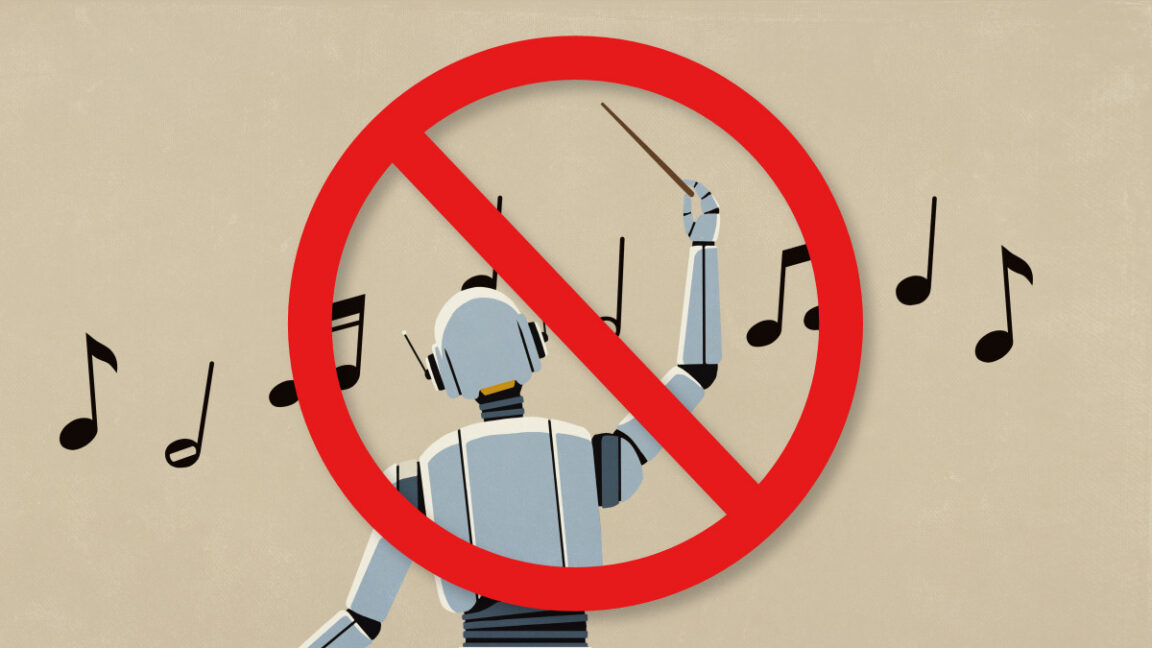
On Tuesday, Bandcamp announced on Reddit that it will no longer permit AI-generated music on its platform. “Music and audio that is generated wholly or in substantial part by AI is not permitted on Bandcamp,” the company wrote in a post to the r/bandcamp subreddit. The new policy also prohibits “any use of AI tools to impersonate other artists or styles.”
The policy draws a line that some in the music community have debated: Where does tool use end and full automation begin? AI models are not artists in themselves, since they lack personhood and creative intent. But people do use AI tools to make music, and the spectrum runs from using AI for minor assistance (cleaning up audio, suggesting chord progressions) to typing a prompt and letting a model generate an entire track. Bandcamp’s policy targets the latter end of that spectrum while leaving room for human artists who incorporate AI tools into a larger creative process.
The announcement emphasized the platform’s desire to protect its community of human artists. “The fact that Bandcamp is home to such a vibrant community of real people making incredible music is something we want to protect and maintain,” the company wrote. Bandcamp asked users to flag suspected AI-generated content through its reporting tools, and the company said it reserves “the right to remove any music on suspicion of being AI generated.”
As generative AI tools make it trivial to produce unlimited quantities of music, art, and text, this author once argued that platforms may need to actively preserve spaces for human expression rather than let them drown in machine-generated output. Bandcamp’s decision seems to move in that direction, but it also leaves room for platforms like Suno, which primarily host AI-generated music.
Two platforms, two approaches, one flood
The policy contrasts with Spotify, which explicitly permits AI-generated music, although its users have expressed frustration with an influx of AI-generated tracks created by tools like Suno and Udio. Some of those AI music issues predate the latest tools, however. In 2023, Spotify removed tens of thousands of AI-generated songs from distributor Boomy after discovering evidence of artificial streaming fraud, but the flood just kept coming.
Last September, Spotify revealed that it had removed 75 million spam tracks over the previous year. It’s a figure that rivals the scale of Spotify’s actual catalog of 100 million tracks. Country music has also been particularly affected by AI music synthesis on Spotify, with AI-generated tracks sometimes topping genre charts above fully human tracks in December 2025.
In a newsroom post from last year, Spotify wrote that it envisioned “a future where artists and producers are in control of how or if they incorporate AI into their creative processes” and that the company wants to leave “those creative decisions to artists themselves.” Spotify focuses its enforcement on impersonation, spam, and deception rather than banning AI-generated content outright.
In some ways, the stark contrast between Bandcamp and Spotify reflects their different business models. Bandcamp operates as a direct marketplace where artists sell music and merchandise to fans, taking a cut of each sale. Spotify pays artists per stream, creating incentives for bad actors to flood the platform with cheap AI content and game the algorithm.
Bandcamp acknowledged the policy may evolve. “We will be sure to communicate any updates to the policy as the rapidly changing generative AI space develops,” the company wrote. The announcement also noted that the company had received feedback about this issue previously, writing, “Given the response around this to our previous posts, we hope this news is welcomed.”
Enforcement remains a question. Detecting AI-generated music is not straightforward, since today’s products of AI synthesis realistically imitate voices and even acoustic instruments. Bandcamp did not specify what tools or methods it would use to identify AI content, only that its team would review flagged submissions. In a world where seemingly unlimited quantities of music can now be created at the push of a button, that’s no minor task.
|
|
|
|
| Keeping Bandcamp Human |
|
Posted by: MIPR - 01-15-2026, 04:34 AM - Forum: 2026
- No Replies
|
|
Keeping Bandcamp Human
Posted by Bandcamp January 13, 2026

Keeping Bandcamp Human
Bandcamp’s mission is to help spread the healing power of music by building a community where artists thrive through the direct support of their fans. We believe that the human connection found through music is a vital part of our society and culture, and that music is much more than a product to be consumed. It’s the result of a human cultural dialog stretching back before the written word.
Similarly, musicians are more than mere producers of sound. They are vital members of our communities, our culture, and our social fabric. Bandcamp was built to directly connect artists and their fans, and to make it easy for fans to support artists equitably so that they can keep making music.
Today we are fortifying our mission by articulating our policy on generative AI, so that musicians can keep making music, and so that fans have confidence that the music they find on Bandcamp was created by humans.
Our guidelines for generative AI in music and audio are as follows:
Music and audio that is generated wholly or in substantial part by AI is not permitted on Bandcamp.
Any use of AI tools to impersonate other artists or styles is strictly prohibited in accordance with our existing policies prohibiting impersonation and intellectual property infringement.
If you encounter music or audio that appears to be made entirely or with heavy reliance on generative AI, please use our reporting tools to flag the content for review by our team. We reserve the right to remove any music on suspicion of being AI-generated.
With this policy, we’re putting human creativity first, and we will be sure to communicate any updates to the policy as the rapidly changing generative AI space develops.
Thank you.
https://blog.bandcamp.com/2026/01/13/kee...amp-human/
|
|
|
|
|